

How to Build an AI Strategy: A Decision-Making Framework

Artificial Intelligence (AI) is no longer a futuristic concept—it’s an operational necessity. Whether your organization is in finance, healthcare, law, education, or technology, AI has the potential to optimize operations, enhance decision-making, and deliver better results with fewer resources. But while the promise is exciting, the process of developing a successful AI strategy requires thoughtful planning, organizational alignment, and practical execution.
Below we will discuss key dimensions that leaders should evaluate regarding how to build an AI strategy framework, covering everything from structural readiness to cybersecurity and compliance.

1. Structural Considerations: Aligning Your AI Team and Time
a. Who Are the Organizational Decision Makers on the AI Strategy?
The success of an AI initiative starts with the right leadership. Typically, this involves a combination of roles:
- CEO: For strategic alignment.
- CPO: For product and service offering implications and modifications.
- CFO: For budgeting and ROI analysis.
- CIO/CTO: For technical feasibility and integration.
- CMO/Head of Product: To ensure product/services alignment with customer needs and market trends.
- Chief Data Officer (CDO) or Head of AI: For data readiness and AI capability building.
- Legal/Compliance Officers: To oversee ethical and regulatory adherence.
Smaller organizations (SMB) may delegate this to a task force or cross-functional team led by an operations or IT head.
b. How Much Time Will Be Required from Them?
AI strategy development isn’t a one-off meeting. Decision-makers must be involved in:
- Initial scoping and feasibility discussions
- AI Readiness Assessment including vendor or platform evaluation
- Risk, ethics, and compliance reviews
- Ongoing performance and ROI reviews
For SMB, expect 4–6 hours per week during the planning phase and 2–4 hours weekly during implementation and monitoring.
c. How Does This Impact Team Composition and Tasks?
AI strategy shifts traditional roles. Tasks that were once manual may be handled by automation or machine learning models. This requires:
- Reskilling staff to work alongside AI or to take on higher-value responsibilities.
- Hiring AI-specific roles such as IT specialists, AI subject matter experts (SME), data scientists, and machine learning engineers.
- Reallocating resources to tasks that require creativity, oversight, or human empathy.
- Potential headcount RIF (reduction-in-force) in how will the organization handle and redistribute a compressed workload.


2. Landscape: Understanding the Market and Preparing for the Future
a. What Are Competitors Doing?
Conduct a competitive AI audit:
- Are they automating processes?
- Are they using AI for fraud detection or contract analysis?
- Have they integrated AI into their supply chain or product design?
Tools like CB Insights for market intelligence, Gartner reports, and LinkedIn competitor tracking can help gather intelligence. Falling behind in AI adoption may not just result in inefficiency—it could lead to market share erosion.
b. How Do We Future-Proof Our Organization?
- Deploy out-of-the-box AI solutions such as ChatGPT or Microsoft Copilot capable of reducing or automating workflows.
- Invest in scalable platforms like Microsoft Azure AI or Google Vertex AI.
- Document your AI models and decision trees so they’re understandable and auditable.
- Choose modular systems that can adapt as new technologies emerge.
- Develop AI governance policies now to ensure future alignment with ethics, privacy, and compliance.

3. Business Determinations: Impact on Revenue Models and Offerings
a. How Does AI Efficiency Affect Our Billing Strategy If We Bill Hourly?
AI automates work that used to take human hours. This creates tension for firms with time-based billing models (like legal, accounting, or consulting firms).
Options include:
- Value-based billing: Price based on outcomes, not time.
- Flat-fee services: Package AI-augmented services with transparent pricing.
- Subscription models: Offer continuous access to AI-powered insights or services.
Your pricing model must evolve as AI increases throughput and reduces effort.
b. How Does This Impact Our Product Offerings?
AI opens the door to:
- New product lines (e.g., predictive analytics reports, automated audits)
- Customized services (e.g., AI-based recommendations or diagnostics)
- Faster delivery and self-service portals for clients
Organizations should reassess their value proposition to integrate AI’s unique capabilities into their customer experience.

4. Technology Choices: Identifying High-Impact Use Cases
a. What Processes Are Costly?
Start with a cost-efficiency audit. Focus on:
- Manual data entry or reconciliation
- Customer service or ticket resolution
- Repetitive report generation
- Document review and compliance checks
These areas are ripe for AI-enabled process automation (RPA) or natural language processing (NLP).
b. What Processes Take a Long Time?
AI excels at reducing time lags in:
- Forecasting and analytics
- Lead scoring and customer segmentation
- Hiring and resume screening
- Quality control in production
Match the AI solution (machine learning, computer vision, NLP, etc.) with the process bottleneck.

5. Measuring ROI: Gauging the Value of AI
You can’t improve what you don’t measure. To build executive confidence in AI investment, define Return On Investment through three major lenses:
a. Efficiency
- Track time saved per process post-implementation.
- Use KPIs such as cases resolved per hour or average handling time.
- Evaluate reductions in downtime, errors, or customer complaints.
b. Shifting Work to Cheaper Resources
- Automate Tier 1 support with chatbots or AI workflows.
- Free up skilled staff for higher-value tasks (strategy, relationship management).
- Reduce reliance on external contractors or overtime.
c. Operating with a Compressed Team
- Use AI to maintain service levels even with leaner staffing.
- This is especially useful during seasonal demand spikes or tight labor markets.
Bonus ROI Areas:
- Faster go-to-market cycles
- More accurate forecasts and decisions
- Improved customer satisfaction

6. Cybersecurity: Navigating the Risks and Reinforcements
a. Does This Impact Our Cybersecurity Strategy?
Yes. Introducing AI into your organization’s ecosystem expands your attack surface. You must:
- Audit AI platforms for vulnerabilities and backdoors.
- Assess data handling practices—especially when using third-party AI models.
- Apply Zero Trust principles to AI-generated or AI-powered operations.
You’ll need to align AI initiatives with your existing security framework, possibly requiring updates to:
- Incident response plans
- Endpoint detection systems
- Network architecture and firewall rule sets
- Data encryption protocols
b. Does This Create Any New Cybersecurity Risks?
Absolutely. Risks include:
- Data poisoning – Where attackers manipulate training data, Large Language Models (LLM), or Small Language Models (SLM).
- Prompt injection attacks – Common in generative AI applications.
- Unauthorized data access – When AI models are trained on sensitive or proprietary data.
Work closely with cybersecurity experts like DAG Tech to conduct AI-specific threat modeling and implement robust access controls and monitoring.

7. Compliance: Ensuring Ethical and Legal Alignment
a. Does This Impact Our Compliance Strategy?
AI may affect how you gather, store, and process data—activities highly regulated in many industries. AI could:
- Violate GDPR or HIPAA rules if data is not anonymized.
- Breach PCI DSS if payment data is processed by unauthorized AI tools.
- Trigger audit or licensing requirements under frameworks like CMMC or SOC 2.
Update your compliance documentation to reflect:
- Organization and End User AI policies and allowed usage
- New data flows
- AI-assisted decision-making
- Vendor risk assessments
b. Does This Alter Our Compliance Adherence?
Yes. Automated decision-making may require:
- Explainability protocols (why did the AI make a specific decision?)
- Human-in-the-loop governance for regulated decisions (e.g., lending, hiring)
- Consent mechanisms when using personal data in training or operation
In some jurisdictions, AI usage must be disclosed to end-users. Ensure your compliance team works alongside your AI team from the start.
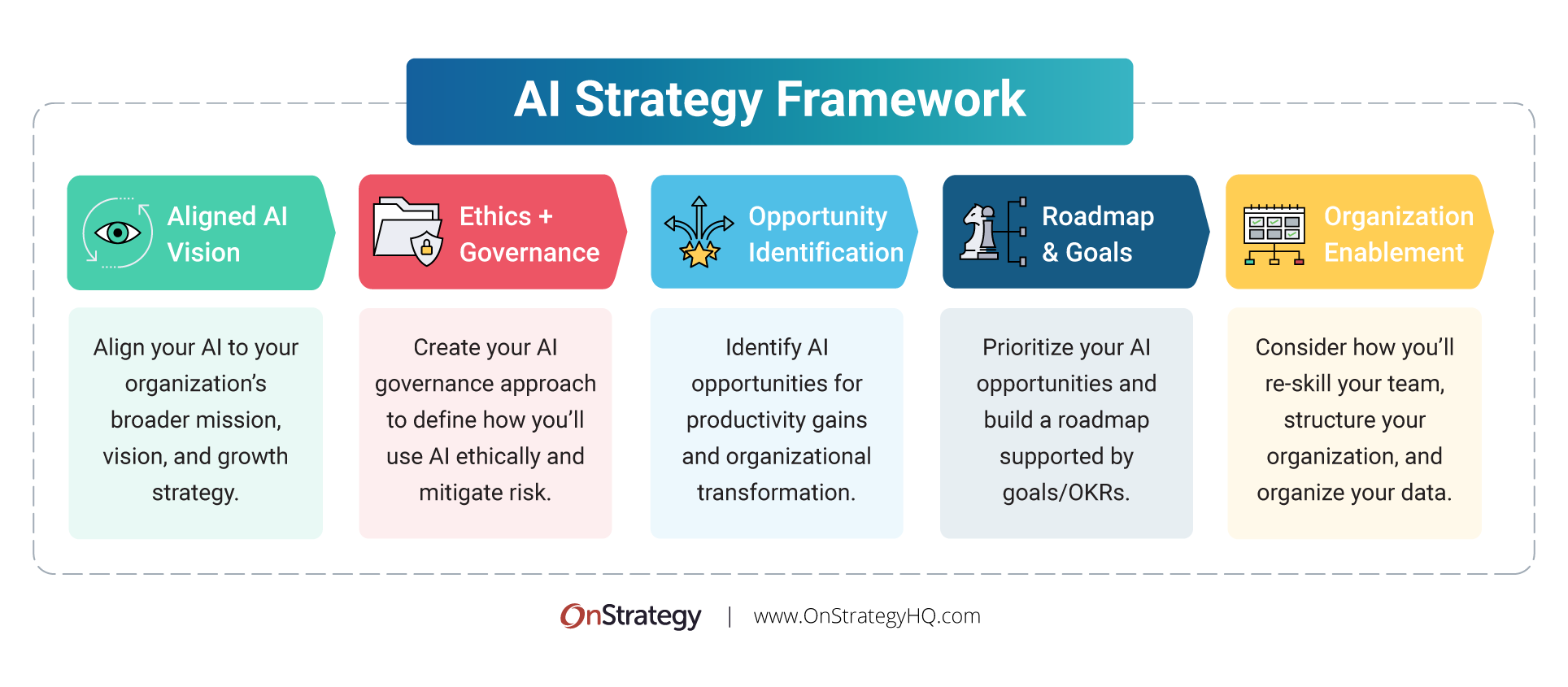
How To Build An AI Strategy Framework That Works for You
AI can offer massive benefits, but success depends on making smart, informed decisions based on your organization’s unique needs and constraints. By evaluating your strategy across structure, landscape, business impact, technology, ROI, cybersecurity, and compliance, you’ll set your business up for sustainable, ethical, and secure AI success.
At DAG Tech, we specialize in AI competencies which empower businesses to navigate this journey. From AI readiness assessments to custom implementation roadmaps, we partner with your leadership team to build AI strategies that drive real results.
Ready to start building your AI strategy? Contact DAG Tech today to schedule a consultation.

Related reading: What Is an AI ROI Assessment? · Implementing Microsoft Copilot for Your Business · What Is an AI Implementation Plan?