What Is an Organization Technology Structure?
What Is an Organization Technology Structure?
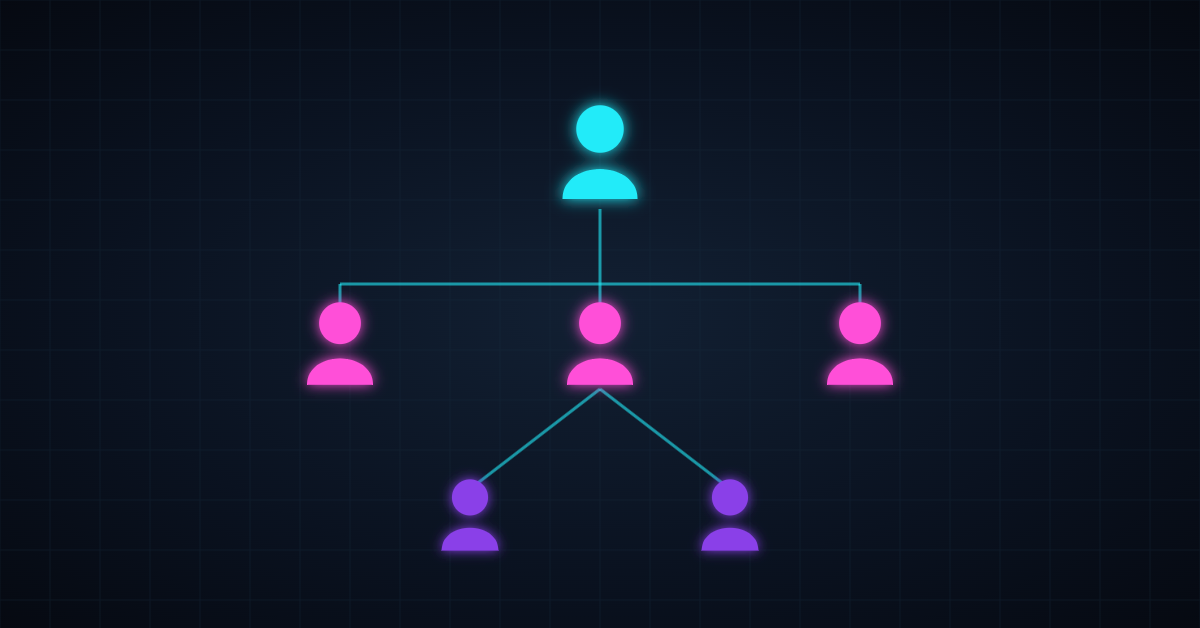
An organization technology structure defines who does what in technology — which functions exist, which are held in-house, which are outsourced, who is accountable for each decision, and where the capacity actually sits.
At DAG Tech, the organization technology structure is a CxO™ Virtual CTO deliverable. Most technology problems we are asked to solve turn out to be accountability problems wearing a technical costume.
Why Technology Accountability Goes Unclear
Technology responsibility rarely gets designed. It accumulates around whoever was available:
- The capable person absorbs everything. One individual becomes the single point of failure for six unrelated systems.
- Outsourced and in-house boundaries blur. Both parties assume the other is monitoring something, and neither is.
- Nobody owns the decisions. Purchases get made departmentally because there is no clear approval path.
- Escalation is informal. Out-of-hours incidents are handled by whoever answers the phone.
- Capacity is invisible. The team is at 130 percent and it only becomes apparent when someone resigns.
How DAG Tech Defines an Organization Technology Structure
1. Map the Current Structure and Load
Objective: Document who actually does what, not what the org chart claims.
- Interview the team on where their time genuinely goes.
- Map every technology function to the person or vendor performing it today.
- Identify functions nobody owns — usually monitoring, licence management and documentation.
- Surface key-person dependencies and undocumented knowledge.
2. Define the Target Operating Model
Objective: Decide which functions the organization should hold and which it should buy.
Some functions belong in-house because they require business context: prioritization, vendor relationships, user-facing support culture. Others are better bought because they require depth and coverage that a small team cannot sustain: security monitoring, after-hours response, specialist engineering. We make that split explicitly rather than by default.
3. Build the RACI and Escalation Map
Objective: Remove ambiguity about who decides and who acts.
- Responsible, accountable, consulted and informed, defined per function rather than per person.
- Approval thresholds for spend, change and exception.
- Escalation paths including out-of-hours, with named roles rather than names.
- The handoff points between your team and any managed services provider.
4. Model Capacity and Coverage
Objective: Establish whether the structure is actually staffable.
Headcount against workload, coverage across hours and sites, on-call rotation viability, and what happens during leave or turnover. A structure that only works when everyone is present is not a structure.
5. Assess Skills and Succession
Objective: Identify the gaps that will bite within a year.
Current capability against the capability the target model requires, key-person risk with mitigation, and development paths for people who want to grow into the gaps rather than being recruited over.
What the Deliverable Actually Looks Like
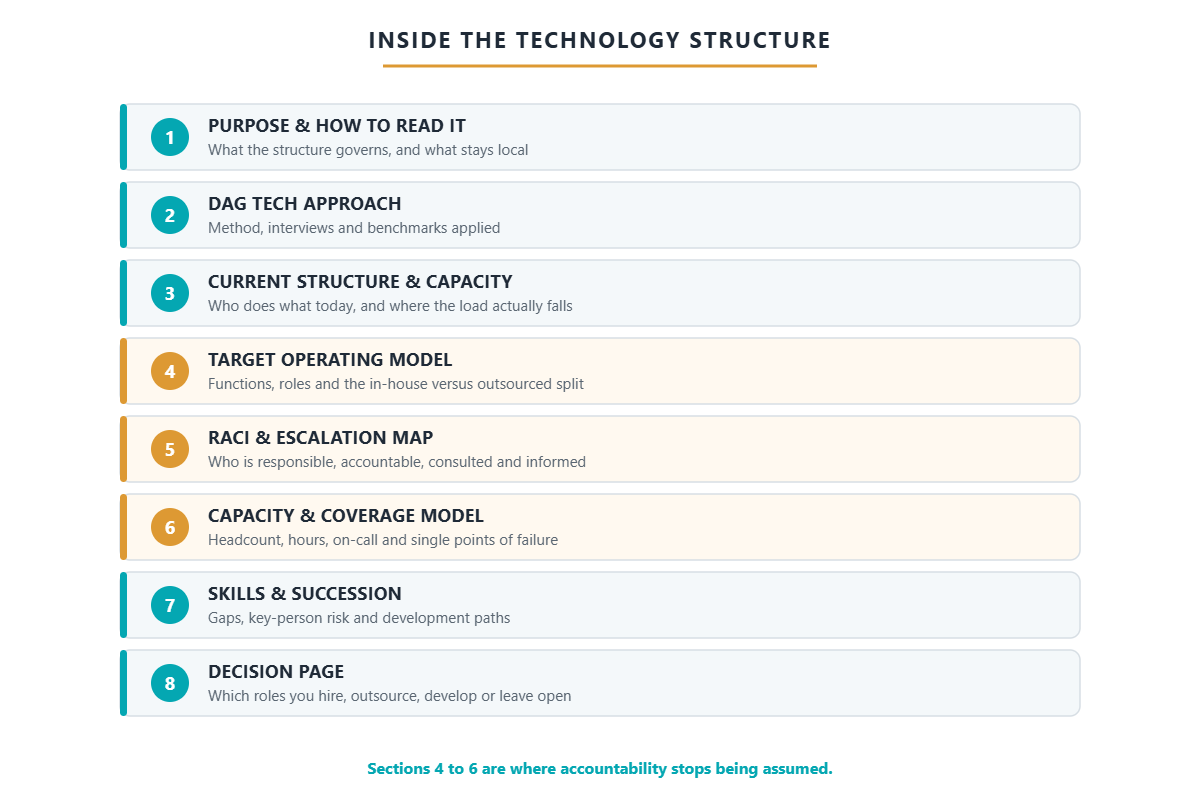
The structure is a document referenced in hiring decisions, vendor negotiations and incident reviews. Ours runs in eight sections.
Sections 1–3: Purpose, approach and current structure
What the structure governs and what stays a local decision, the method and benchmarks applied, then the current picture — who does what today and where the load actually falls, including the functions nobody owns.
Sections 4–6: Target model, RACI and capacity
The target operating model, the accountability map and the capacity model. Every function in the target carries the same fields:
- Number and function — stated as work performed, not as a job title.
- Delivery model — in-house, outsourced, or shared with the split defined.
- Accountable role — one role, not a committee.
- Coverage required — business hours, extended or 24/7.
- Estimated effort — in hours or FTE, so capacity can be summed.
- Skills required — and whether they exist internally today.
- Escalation path — where it goes when the first line cannot resolve it.
Sections 7–8: Skills, succession and the decision page
Capability gaps, key-person risk and development paths, then a decision page listing every function so leadership can decide what to hire for, what to outsource, what to develop internally and what to deliberately leave uncovered.
Leaving something uncovered is a legitimate decision when it is made knowingly. Most coverage gaps are not.
Where the Technology Structure Fits
The organization technology structure is a CxO™ Virtual CTO deliverable that pairs with the technology assessment and TCO study — the assessment shows what must be operated, the TCO study shows what it costs, and the structure decides who does it.
Most organizations do not need more technology people. They need the ones they have pointed at clearly defined work.
Contact DAG Tech today to scope an organization technology structure review.
Related reading: What Is an IT E-Learning Program? · What Is an End-user Technology Policy? · Sustainable IT: Greener by Design