
IT Consultant vs. Managed IT Provider: Which Does Your Los Angeles Business Need?
Do You Need an IT Consultant or a Managed IT Provider?
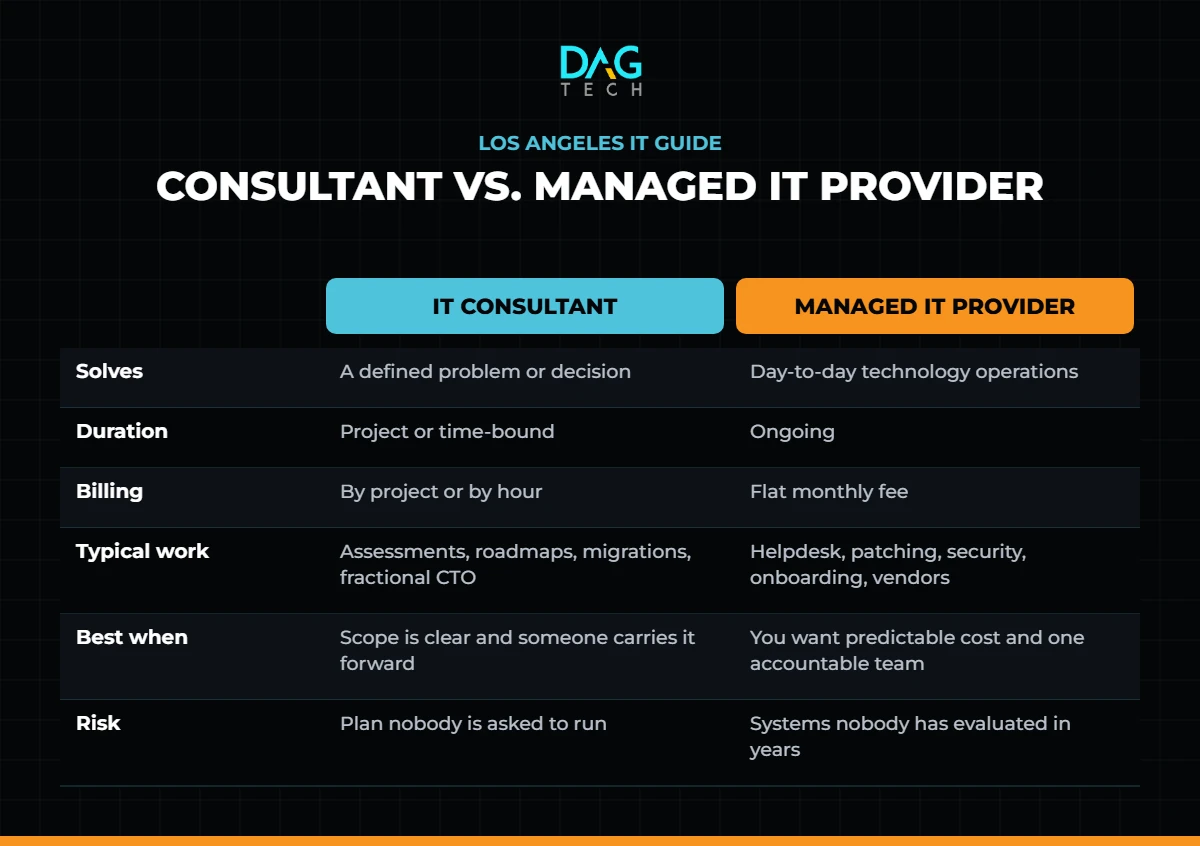
An IT consultant solves a defined problem and leaves; a managed IT provider runs your technology every day for a fixed monthly fee. If your pain is a specific decision or project — a cloud migration, a security strategy, an office build-out — you need consulting. If your pain is that things keep breaking, nobody owns security and staff wait too long for help, you need managed IT. Many growing organizations need both, delivered by one team so strategy and execution stay connected.
Los Angeles makes the distinction matter. Studios, agencies, professional-services firms and growing companies from Downtown to the Westside often outgrow an informal IT setup quickly, and the wrong engagement model is an expensive way to learn it. Here is how to decide, and what to look for in IT services in Los Angeles once you have.

The Difference at a Glance
What an IT Consultant Does
Consulting is scoped, time-bound and decision-focused. Typical engagements include:
- Assessments. An independent technology assessment of what you have, what is at risk and what to change.
- Strategy and roadmaps. A technology plan tied to business goals, budget and growth — including how AI can make your teams faster and smarter through AI consulting.
- Projects. Cloud migrations, network redesigns, office moves and system implementations.
- Fractional leadership. A part-time CTO or security leader who owns decisions without a full-time executive salary.
- Vendor decisions. A structured vendor evaluation study before you commit to a platform or provider.
Consulting is usually billed by project or by hour. It works best when the scope is clear and someone internally can carry the result forward.
What a Managed IT Provider Does
Managed IT is ongoing and operational. A managed provider typically covers:
- Helpdesk support for every user, with a defined response time.
- Proactive maintenance — patching, monitoring and fixing problems before users notice them.
- Security operations — endpoint protection, email security, backups and 24/7 monitoring.
- User lifecycle — onboarding, offboarding, devices and accounts.
- Vendor management — carriers, software vendors and hardware warranties.
Managed IT is usually a flat monthly fee. It works best when you want predictable cost and one accountable team for day-to-day technology. Because a managed provider holds privileged access to everything you run, review CISA’s risk considerations for managed service provider customers before you sign.
Consulting decides what to do. Managed IT makes sure it keeps working. The best results come when the same team is accountable for both.
Five Signs You Need Each
You need a consultant if:
- You have a specific project with a start and an end.
- You are making a decision you will live with for years, such as a cloud platform or a security framework.
- Your board, investors or clients are asking questions about technology risk you cannot answer.
- You already have capable IT staff who need direction, not more hands.
- You want an independent opinion on your current provider.
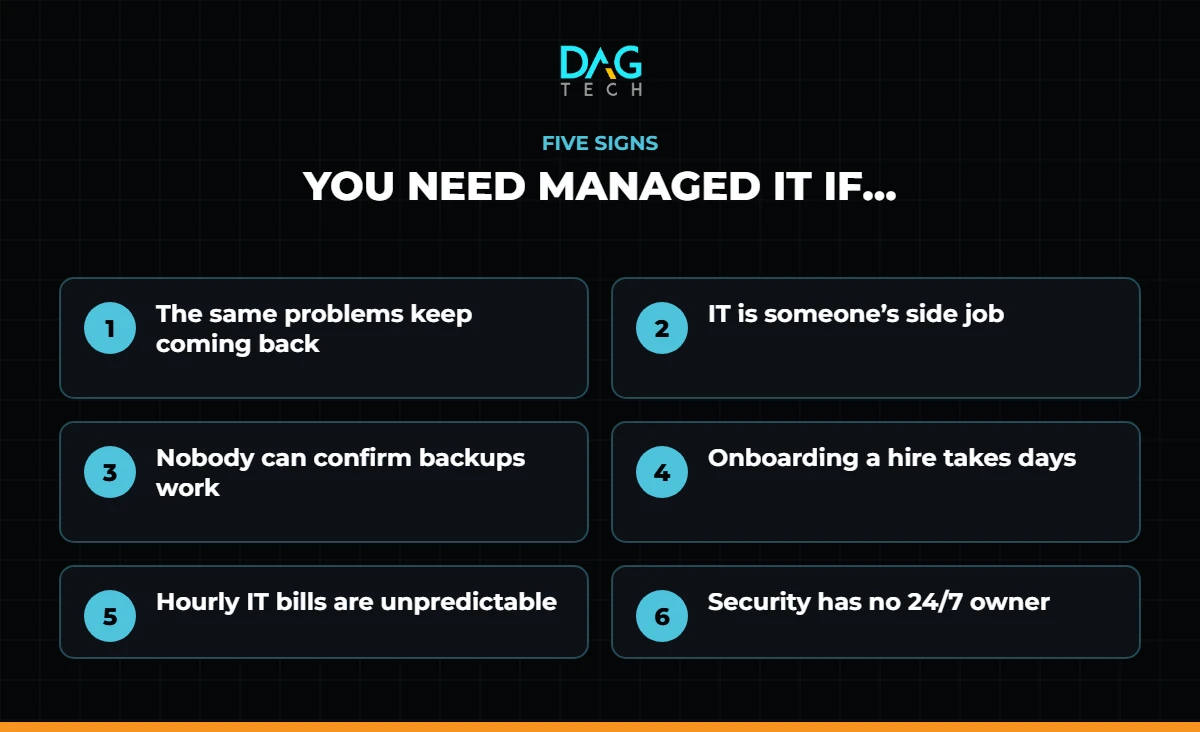
You need a managed IT provider if:
- The same problems keep coming back.
- IT is someone’s side job.
- Nobody can tell you with confidence that backups work and devices are patched.
- Onboarding a new hire takes days instead of hours.
- You are paying hourly for support and the bills are unpredictable.
Why Many Organizations Need Both
The most common failure is splitting strategy and operations between parties who never talk: a consultant designs a plan the support provider was never asked to run, or a support provider runs systems nobody has evaluated in years. The better model pairs a fractional technology leader with a managed team that executes the plan — so decisions, projects and daily support follow one roadmap and one organization technology structure.
A common yardstick for both is the NIST Cybersecurity Framework 2.0: a good consultant tells you where you stand against it, and a good managed provider keeps you there.
Questions to Ask Before You Sign
- Is the engagement scoped to an outcome, or to hours?
- Who owns the result once the consultant leaves?
- For managed IT, what is the measured average response time, and what does the fee include?
- Can the same firm handle strategy, projects and support if you need all three?
- Does the provider protect its own access with phishing-resistant multifactor authentication?
Where DAG Tech Fits
DAG Tech delivers both models under one roof:
- Consulting: fractional CTO and virtual CTO leadership through our CxO practice, IT assessments including the State of the Technology assessment, and IT project services.
- Operations: managed IT services on flat-rate plans with an 8-minute average helpdesk response, or IT Team-as-a-Service when you need dedicated staff.
See what clients say in DAG Tech’s reviews.
Contact DAG Tech today — we deliver proposals within one business day.
Related reading: Moving to the Cloud: A Practical Guide for Los Angeles Businesses · Earthquake-Ready IT: Disaster Recovery for Southern California Offices · What Is a Technology TCO Study?