What Is an AI Implementation Plan?
What Is an AI Implementation Plan?
An AI Implementation Plan is the engineering-level document that turns AI intent into working systems. Where an AI Readiness Assessment tells you whether your organization is prepared and an AI Strategy Roadmap tells you what to build and in what order, the Implementation Plan specifies exactly how each use case gets built, connected, secured, tested, and operated inside your existing environment.
At DAG Tech, our Artificial Intelligence SME team builds Implementation Plans that name real systems, real APIs, real data objects, and real workflow steps. No generic slideware. The deliverable is detailed enough that an engineer — ours or yours — can build from it.

Why Most AI Projects Stall at Implementation
Pilots are easy. Production is where AI projects die. The failure is almost never the model — it is the plumbing around it. Common causes:
- No system of record clarity: Nobody defined which system owns the data the AI is acting on, so outputs conflict with the source of truth.
- Missing or fragile connectors: The workflow depends on a platform with no usable API, a legacy database, or a vendor tool locked behind a per-seat license.
- Undefined workflow boundaries: The AI is asked to "handle intake" without anyone specifying where the handoff to a human occurs.
- No measurement instrumentation: There is no baseline, so nobody can prove the AI improved anything.
- Security and compliance reviewed last: The build is finished, then legal stops it.
An AI implementation plan resolves all five before a line of code is written.
How DAG Tech Builds an AI Implementation Plan
1. Business Function Decomposition
Objective: Break the targeted business function into discrete, observable steps.
We start with the function, not the technology. Accounts payable, client intake, service desk triage, quoting, claims review, onboarding — each gets decomposed into the actual sequence of actions performed today.
- Map each step to the person or role who performs it.
- Capture inputs, outputs, decision points, and exception paths.
- Record volume, cycle time, and error rate for each step to establish a baseline.
- Classify every step as deterministic (rule-based, calculable) or judgment-based (requires interpretation).
That last classification drives the entire design. Deterministic steps belong in code or workflow automation, where they are predictable and auditable. Judgment-based steps are the ones where AI earns its keep. Applying a language model to arithmetic or date logic is a common and expensive mistake.
2. Systems and Data Inventory
Objective: Identify every system the workflow touches and what each one holds.
Building on the IT assessment work, we document:
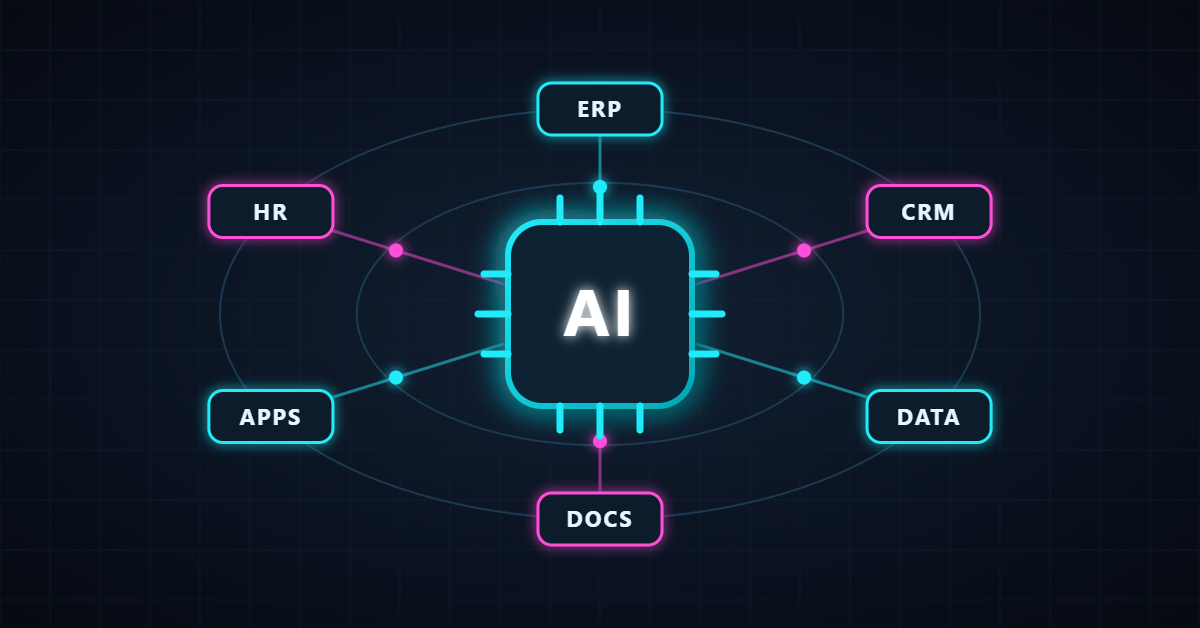
- Systems of record: ERP, CRM, PSA, EHR, ticketing, document management, finance, HRIS.
- Data objects and schemas: The specific entities and fields the AI will read or write.
- Data quality and lineage: Where records originate, how they are updated, and how often they are wrong.
- Access and identity: Which identities, service accounts, and permission scopes will be required.
- Shadow IT: The spreadsheets, shared mailboxes, and departmental tools that silently carry part of the process.
Shadow systems surface constantly in this phase. They are usually load-bearing, and an AI implementation plan that ignores them breaks on day one.
3. Connector and API Architecture
Objective: Determine how the AI will actually reach each system.
This is the most technical section of the plan and the one most often skipped elsewhere. For every integration point we document:
- Interface type: Native REST or GraphQL API, vendor connector, webhook, message queue, iPaaS platform, database view, RPA, or file-based exchange.
- Authentication model: OAuth 2.0, service principal, API key, certificate — plus credential storage, rotation, and ownership.
- Direction and trigger: Read-only, write-back, or bidirectional; event-driven or scheduled.
- Rate limits and quotas: Calls per minute, payload ceilings, and what the workflow does when a limit is hit.
- Latency budget: Acceptable response time for each hop in the chain.
- Failure behavior: Retry logic, idempotency, dead-letter handling, and rollback.
- Model access pattern: Whether the AI consumes tools and context through a standard protocol such as the Model Context Protocol, a vendor SDK, or a custom middleware layer.
Where no viable interface exists, we say so and price the alternative — a middleware layer, a data staging table, a vendor upgrade, or a replacement system. That is a strategic finding, not a footnote.

4. AI Solution Design and Model Selection
Objective: Specify what the AI does at each judgment point and which technology performs it.
- Approach per use case: Large language model, retrieval-augmented generation, classical machine learning, classification, OCR and document extraction, or agentic workflow.
- Model and hosting: Commercial API, private cloud deployment, or on-premises — evaluated against data residency, cost, and performance requirements.
- Context and grounding: Which documents, records, and knowledge sources the model retrieves from, and how that index stays current.
- Prompt and tool specification: The instructions, tool definitions, and output schemas that govern behavior.
- Guardrails: Input validation, output constraints, confidence thresholds, and escalation triggers.
- Cost model: Projected token or inference volume at expected transaction levels, with a per-transaction cost.
We design for a durable split: deterministic logic stays in code where it can be tested and audited, and the model handles only the interpretive work. This keeps output stable, cost predictable, and troubleshooting straightforward. A good AI implementation plan records these choices in writing so they can be revisited as models and pricing change.
5. Workflow Orchestration and Human Checkpoints
Objective: Define the end-to-end runtime flow, including where people stay in the loop.
- Sequence every step: trigger, data retrieval, inference, validation, write-back, notification.
- Define human review gates by risk tier — approval required, review-on-exception, or fully automated.
- Specify confidence thresholds that route low-certainty outputs to a person.
- Document the audit trail: what gets logged, where it is stored, and how long it is retained.
- Design the fallback path for when the AI or a connector is unavailable, so the business function continues.
An AI implementation plan that skips this step tends to produce automation nobody trusts enough to leave running.
6. Security, Governance, and Compliance Controls
Objective: Build controls into the design rather than bolting them on after the fact.
Working alongside our managed cybersecurity and compliance teams, the plan specifies:
- Data classification and what categories may never reach an external model.
- Least-privilege scoping for every service account and connector.
- Secrets management, key rotation, and network egress controls.
- Tenant and vendor terms covering training data use and retention.
- Regulatory alignment with HIPAA, GDPR, CMMC, SOX, or the frameworks that apply to you.
- Acceptable use policy and governance structure for AI in production, consistent with recognized frameworks such as the NIST AI Risk Management Framework.
7. Build Sequence, Testing, and Deployment
Objective: Produce an executable project plan with acceptance criteria.
This is the part of the AI implementation plan your delivery team works from week to week.
- Phased sequence: Connector and data work first, then inference, then orchestration, then user interface.
- Environments: Development, staging with representative data, and production.
- Test plan: Golden-set evaluation cases with expected outputs, accuracy targets, adversarial and edge-case testing, and load testing at peak volume.
- Acceptance criteria: Explicit numeric thresholds that must be met before production release.
- Rollout method: Shadow mode, limited pilot group, then phased expansion — delivered through our strategic IT project methodology.
- Training and adoption: Role-specific enablement for the people whose work changes.
8. Measurement, Monitoring, and Optimization
Objective: Prove the outcome and keep it stable.
- KPIs tied to the Step 1 baseline: cycle time, cost per transaction, error rate, throughput, deflection rate.
- Operational monitoring for API health, latency, token consumption, and cost per period.
- Quality monitoring for output drift, escalation rate, and user override frequency.
- A defined review cadence and ownership for prompt, model, and connector updates.
These metrics feed directly into the AI Performance, Impact, and ROI Assessment that follows implementation. Until they move, an AI implementation plan is a hypothesis rather than a result.
What the Deliverable Actually Looks Like
An AI implementation plan is a document your leadership team reads and makes funding decisions from, so its structure matters as much as its analysis. Ours runs in eight sections.

Sections 1–2: Purpose and approach
The document opens by stating what an AI implementation plan decides and what it deliberately leaves open, so nobody reads it expecting a signed statement of work. The second section covers DAG Tech’s relevant proficiencies — the integration, security and infrastructure work behind the recommendations — and explains how to navigate the rest of the document.
Section 3: Your AI objectives
A plain-language statement of what your organization wants AI to do, written back to you in your own terms. Business outcomes sought, constraints you have set, systems that are off limits, and the criteria by which you will judge success. Everything that follows is traceable to this section, and if we have understood it wrong, that is visible on page three rather than page forty.
Section 4: Current-state findings
The systems, data, connector and workflow analysis described earlier in this article, written up as findings: what exists, what is usable, what is missing, and which constraints shape the options.
Section 5: Candidate initiatives
The core of the document. Every viable AI implementation is specified individually, and each entry carries the same fields:
- Number and name — so it can be referenced in a budget conversation.
- Business function and current pain — what it fixes, with the baseline measure.
- What gets built — systems touched, connectors required, model and retrieval approach.
- Prerequisites and dependencies — including any other initiative that must come first.
- One-time implementation cost — build, integration, testing and enablement.
- Ongoing cost — licensing, inference, support and maintenance, stated per month or per transaction.
- Total cost of ownership impact — the net effect on your run costs, which for some initiatives is a reduction.
- Benefit type and size — increased productivity, reduced resource requirement, faster cycle time, lower total cost of ownership, or reduced risk, with an estimated magnitude and a confidence level.
- Effort and duration — what it takes to deliver and how long.
- Risk rating — technical, adoption and compliance risk.
Identical fields across every entry is the point. It lets you compare a service desk automation against an invoice-coding automation on the same terms rather than on how compelling each one sounds.
Section 6: Ranking and scoring
Each initiative is scored on business impact, technical feasibility, cost, risk and dependency, then ranked and numbered. The scoring method is published in the document, so you can disagree with a weighting and see immediately how the order changes. A ranking you cannot interrogate is just an opinion with numbers attached.
Section 7: The phased roadmap
The ranked initiatives are grouped into phases that respect dependencies and build capability in a sensible order — early phases establish the connector and governance groundwork that later ones rely on.

Section 8: Commercials, risks and the decision page
Consolidated costs across the roadmap, one-time and recurring, with a multi-year total cost of ownership view. Then the assumptions the estimates rest on, the risks and how they are mitigated, and finally a single decision page listing every numbered initiative so your team can select what to fund, defer or decline.
That last page is the purpose of the whole document. The plan is not a recommendation to accept or reject as a block — it is a menu of specified, costed, ranked options, and you choose.
Where the Implementation Plan Fits
The AI Implementation Plan is one deliverable within DAG Tech’s CxO™ Artificial Intelligence SME program, alongside the AI Readiness Assessment, AI Strategy Roadmap, AI Performance and ROI Assessment, and ongoing AI Adoption Guidance. Engage it as a standalone project, or bundle it with our wider AI implementation services as part of a broader digital transformation effort.
Organizations that already know what they want to build come to us for this document specifically. Organizations still deciding usually start with readiness and roadmap, then move here. Either way, the plan is what turns AI implementation services into something your team can actually execute.
AI delivers value when it is wired correctly into the systems and workflows your business already runs on. That wiring is what an Implementation Plan defines.
Contact DAG Tech today to scope an AI Implementation Plan for your organization.
Related reading: How to Create AI Policies · DAG Tech’s Artificial Intelligence Competencies · How Does AI Impact Business Cybersecurity?