

What Is an AI ROI Assessment?
What Is an AI ROI Assessment?
An AI ROI assessment measures what your AI deployments actually returned — in cost, time, quality, and risk — against what they actually cost to build and run. It is the deliverable that answers the question every executive sponsor asks about six months in: did this work, and should we do more of it?
At DAG Tech, the AI ROI assessment is the formal fourth stage of our Artificial Intelligence SME program, following the AI Readiness Assessment, the AI Strategy Roadmap, and the AI Implementation Plan. It is where claims get replaced with numbers.
Why AI ROI Is So Often Unprovable
Most organizations cannot answer whether their AI investment paid off. Not because the value is absent, but because nobody instrumented the question. The recurring reasons:
- No baseline was captured. The old process was never measured, so there is nothing to compare the new one against.
- Costs are scattered. Inference spend sits in one budget, licensing in another, and the human review time nobody counts sits in a third.
- Benefits are asserted, not attributed. Cycle time dropped, but so did volume that quarter. Which caused which?
- Quality is unmeasured. Throughput doubled while error rates quietly rose, and the rework is invisible in the numbers.
- Pilot economics get extrapolated. A hand-held pilot with a senior engineer babysitting it is projected across the enterprise as though it will behave the same way.
An AI ROI assessment fixes the measurement problem before it tries to answer the value question.
How DAG Tech Conducts an AI ROI Assessment
1. Reconstruct or Confirm the Baseline
Objective: Establish what the process cost and how it performed before AI.
- Pull pre-deployment volumes, cycle times, error and rework rates, and staffing allocation.
- Where no baseline was captured, reconstruct one from ticket logs, timestamps, payroll allocation, and system audit trails.
- Normalize for seasonality and volume shifts so the comparison is like-for-like.
- Document baseline confidence explicitly — a reconstructed baseline is weaker evidence than a measured one, and the report says so.
2. Build the Full Cost Picture
Objective: Capture every cost the AI carries, not just the obvious one.
- Inference and API spend: Token or transaction costs at actual production volume, not pilot volume.
- Infrastructure: Hosting, vector or search indexes, storage, networking, and environments.
- Licensing: Platform, connector, iPaaS, and per-seat costs introduced by the deployment.
- Build and integration: Amortized engineering effort, including project delivery and connector work.
- Human-in-the-loop time: Review, correction, and escalation handling — the cost most often omitted, and often the largest.
- Run and maintain: Monitoring, prompt and model updates, retraining, and incident response.
Total cost of ownership, not sticker price. A workflow that saves twenty minutes but adds a five-minute mandatory review at twice the hourly rate has not saved anything.
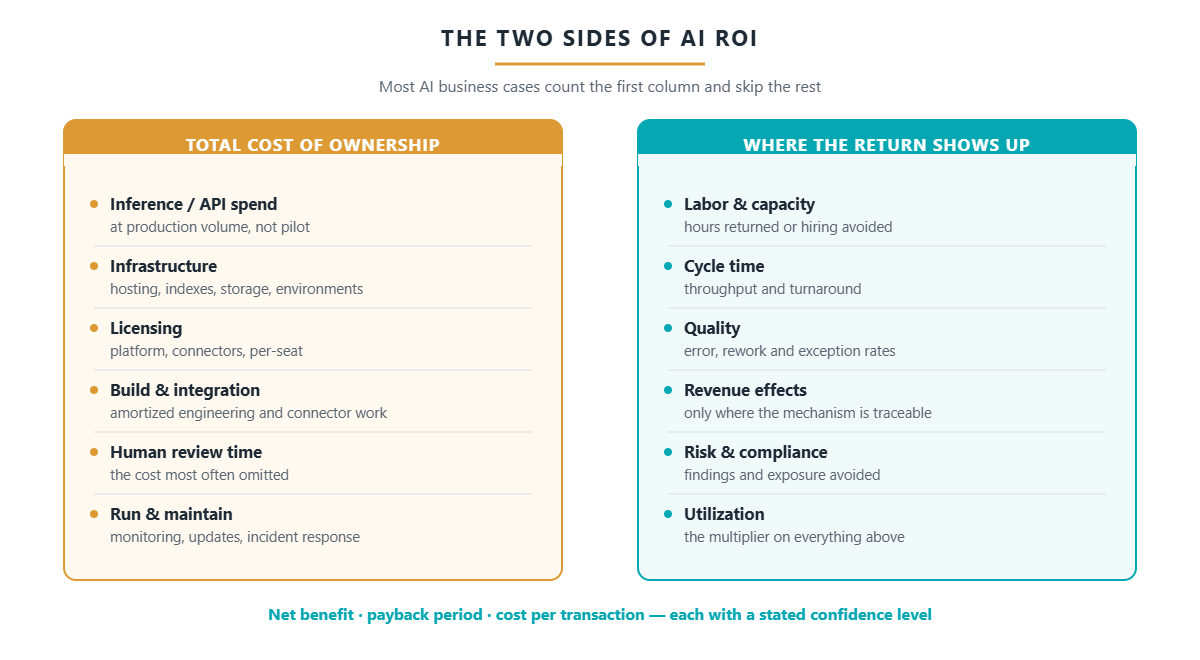
3. Quantify the Benefits — and Attribute Them Honestly
Objective: Separate what the AI caused from what happened to coincide with it.
- Labor and capacity: Hours returned, converted to redeployed capacity or avoided hiring — stated as whichever actually occurred.
- Cycle time: Throughput and turnaround improvements, and what they unlocked downstream.
- Quality: Error rates, rework volume, exception frequency, and customer-visible defects.
- Revenue effects: Faster quoting, higher contact rates, reduced churn — attributed only where the mechanism is traceable.
- Risk and compliance: Audit findings, control failures, and exposure avoided.
Attribution is where most of an AI ROI assessment goes wrong. Where a controlled comparison exists — a held-back team, a phased rollout, a shadow-mode period — we use it. Where it does not, we say the number is directional and explain what would make it defensible. Confident false precision is worse than an honest range.
4. Assess Quality and Model Behavior
Objective: Confirm the gains are real and not borrowed from quality.
An AI ROI assessment that reports throughput without reporting quality is measuring half the picture.
- Sample production outputs against a scored rubric rather than relying on user sentiment.
- Measure human override and correction rates, and whether they are trending up or down.
- Check for drift: performance on today’s inputs versus performance at launch.
- Review escalation and fallback frequency, and what happens to the work that falls through.
- Identify silent failures — outputs accepted downstream that were wrong and never caught.
5. Assess Adoption Reality
Objective: Establish whether the deployment is actually being used as designed.
Utilization is the single largest driver of realized return. A tool licensed for 400 people and used by 60 has a per-user cost nearly seven times the plan. We measure active usage against eligible population, workflow coverage, and workaround behavior — where people have quietly reverted to the old method. Where adoption is the gap, that finding routes into AI adoption guidance rather than a technology fix.
6. Model the Financial Return
Objective: Produce the numbers a CFO will accept.
- Net benefit, payback period, and return on investment over a stated horizon.
- Cost per transaction, before and after.
- Sensitivity analysis across volume, unit inference cost, and adoption rate.
- Scaling economics — which costs are fixed, which are linear, and where the curve bends.
- A stated confidence level for each figure, with the evidence behind it.
- A portfolio view where several use cases are live — Gartner argues AI should be assessed as a set of different bets rather than one ROI formula, and we model it that way.
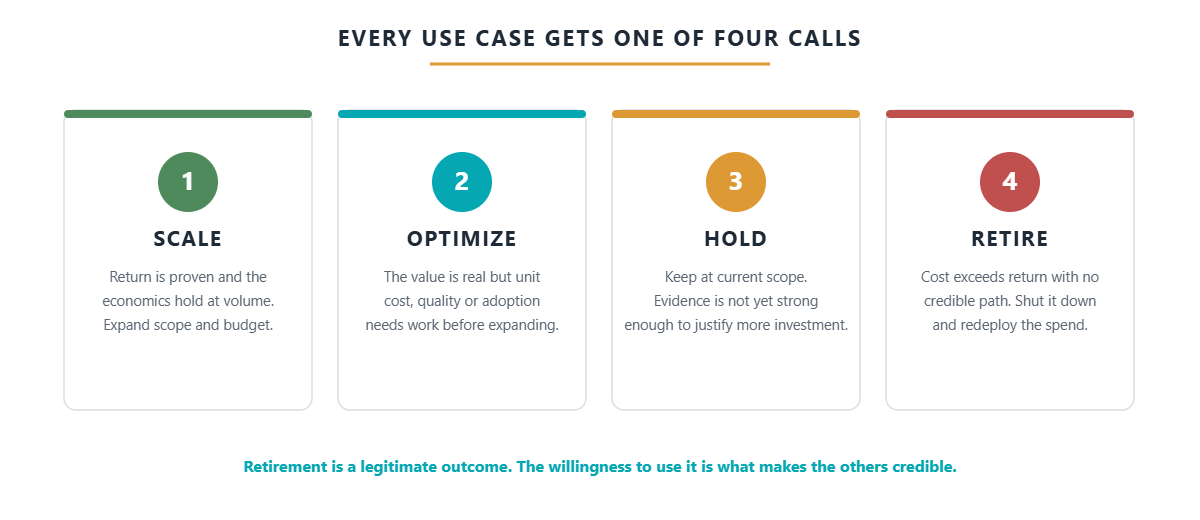
7. Issue a Decision Recommendation
Objective: Convert the analysis into a call.
Every assessed use case receives one of four recommendations: scale it, optimize it before scaling, hold it at current scope, or retire it. Retirement is a legitimate outcome and appears in our reports. The discipline to shut down an underperforming deployment is what makes the rest of the portfolio credible.
What the Deliverable Actually Looks Like
The assessment is a document a CFO reads and makes funding decisions from, so its structure matters as much as its analysis. Ours runs in eight sections.
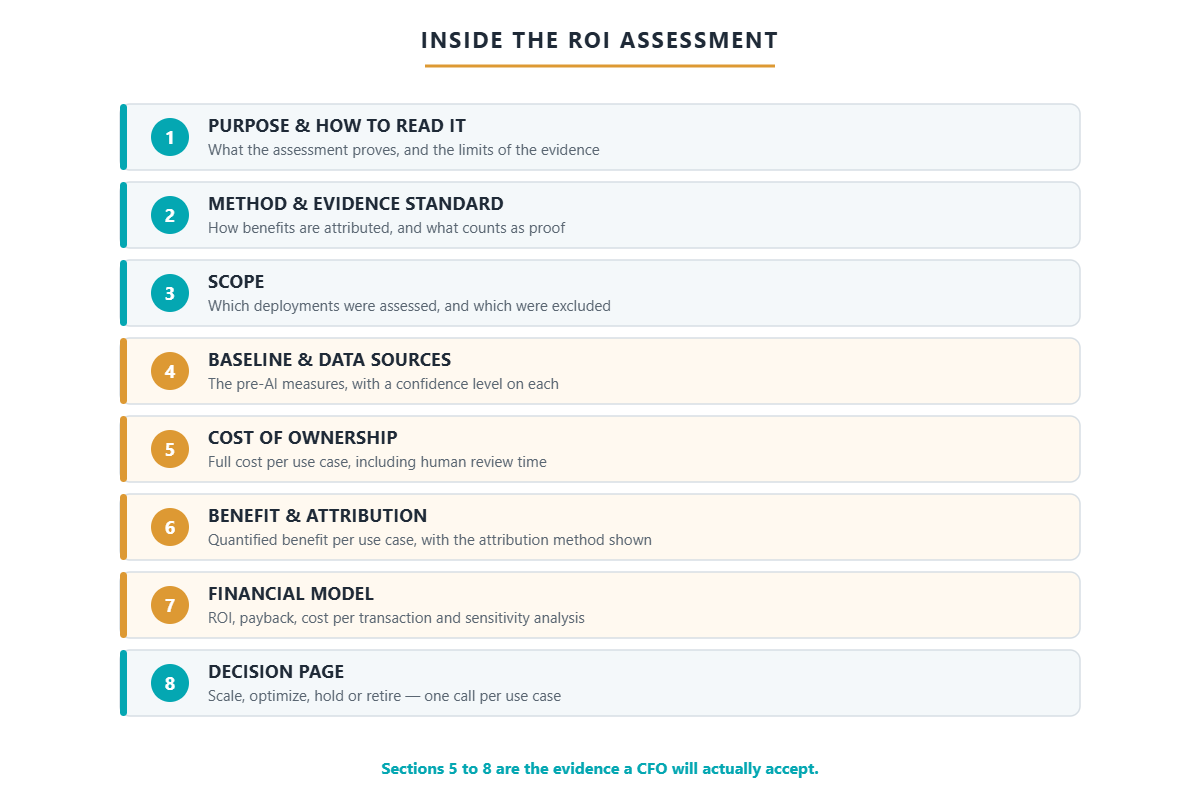
Sections 1–3: Purpose, method and scope
What the AI ROI assessment proves and where the evidence stops, the attribution method and what we treat as proof, and exactly which deployments were assessed — including any excluded, and why. Stating the method up front is what makes the numbers later in the document arguable rather than assertable.
Section 4: Baseline and data sources
The pre-AI measures for every assessed process, each tagged with its source and a confidence level. Measured baselines and reconstructed baselines are labelled differently, because they are not equally strong evidence and the reader is entitled to know which one they are looking at.
Section 5: Cost of ownership
Full cost per use case, broken out across inference, infrastructure, licensing, amortized build, human review time and ongoing maintenance. Human review time is reported separately rather than folded in, because it is the line that most often turns an apparent saving into a wash.
Section 6: Benefit and attribution
Quantified benefit per use case, with the attribution method shown for each figure. Every entry carries the same fields:
- Number and use case — matching the original implementation plan numbering.
- Benefit type — productivity, resource reduction, cycle time, lower total cost of ownership or risk reduction.
- Measured change — against the stated baseline.
- Attribution basis — controlled comparison, phased rollout, shadow period, or directional estimate.
- Confidence level — stated, not implied.
- Quality check — override rate, drift and error trend reported alongside the benefit.
- Utilization — active usage against eligible population, since it scales everything above it.
Section 7: The financial model
Net benefit, payback period, return on investment over a stated horizon, and cost per transaction before and after. Sensitivity analysis runs the model across volume, unit inference cost and adoption rate, so leadership can see which assumption the result actually depends on.
Section 8: The decision page
One call per use case — scale, optimize, hold or retire — on a single page, each with the evidence reference behind it. Retirement recommendations appear here in the same format as the others, with the redeployable spend stated.
That page is the purpose of the whole document. It is not a verdict on your AI programme as a block; it is a per-item portfolio decision, and you make it.
When to Run an AI ROI Assessment
The useful points are 90 days after a deployment reaches steady-state production, before any decision to expand scope or budget, and on an annual cycle once several use cases are live. Running one during a pilot produces pilot economics, which rarely survive contact with production volume.
Organizations with a single deployment use the assessment to decide whether to continue. Organizations with several use the AI ROI assessment as portfolio management — concentrating investment where returns are proven and cutting what is not working.
AI spending is easy to justify in a business case and hard to defend a year later. An AI ROI assessment is how you defend it with evidence.
Contact DAG Tech today to scope an AI ROI assessment for your organization.
Related reading: How to Create AI Policies · DAG Tech’s Artificial Intelligence Competencies · Implementing Microsoft Copilot for Your Business