
What Is a Digital Foundation Plan?
What Is a Digital Foundation Plan?
A digital foundation plan defines the technology standard your organization runs on — how identity, devices, network, data, backup and security are configured everywhere, consistently — and sets out how to bring the estate to that standard.
At DAG Tech, the digital foundation plan is a CxO™ Virtual CTO deliverable that sits between the technology assessment, which establishes what you have, and the digital transformation plan, which pursues change. Foundation work comes first, because transformation built on an inconsistent base multiplies the inconsistency.
Why Foundations Drift
Almost no organization sets out to run six device configurations. It happens gradually:
- Every project set its own standard. Each was reasonable in isolation, and no two agree.
- Sites were built by different people. The Chicago office works differently from Dallas because different hands built it.
- Acquisitions were never normalized. Two identity providers, two backup products, two ways of onboarding staff.
- Exceptions became permanent. A temporary workaround for one team is now load-bearing.
- Nobody owns the standard. There is no document to be consistent with.
The cost is invisible but continuous: every support ticket takes longer, every rollout needs bespoke handling, and every security control has gaps where the exceptions live.
How DAG Tech Builds a Digital Foundation Plan
1. Establish the Target Standard
Objective: Define what good looks like for your organization specifically.
- Identity: Directory, authentication, conditional access, privileged access and joiner-mover-leaver process.
- Device: Build standard, management, patching, encryption and lifecycle.
- Network: Segmentation, remote access, connectivity standards per site type.
- Data: Where data lives, classification, retention and access model.
- Backup and recovery: Coverage, retention, immutability and tested recovery objectives.
- Security baseline: Endpoint protection, logging, monitoring and the controls under it, aligned with our managed cybersecurity practice.
2. Measure the Gap
Objective: State the distance between current and target, per domain and per site.
The gap is recorded as specific deviations rather than a maturity score: forty-two devices not encrypted, three sites without segmentation, two departments outside the identity standard. Deviations are countable, and counting them is what makes progress visible later.
3. Cost and Sequence the Standardization
Objective: Turn the gap into a fundable programme.
- Each standard costed separately — one-time and any recurring change.
- Sequenced by dependency: identity usually first, because device and data controls rely on it.
- Disruption assessed honestly, including what requires user communication or downtime.
- Quick wins identified where a standard can be applied estate-wide in days.
4. Build Drift Control
Objective: Ensure the standard survives contact with the next project.
A standard without enforcement decays within a year. The plan defines who owns each standard, how compliance is monitored, the exception process and its review cadence, and which gates new projects must pass. An exception with an expiry date and an owner is manageable; an undocumented one becomes permanent.
What the Deliverable Actually Looks Like
The plan is a reference document your team works from for years, so its structure matters as much as its content. Ours runs in eight sections.
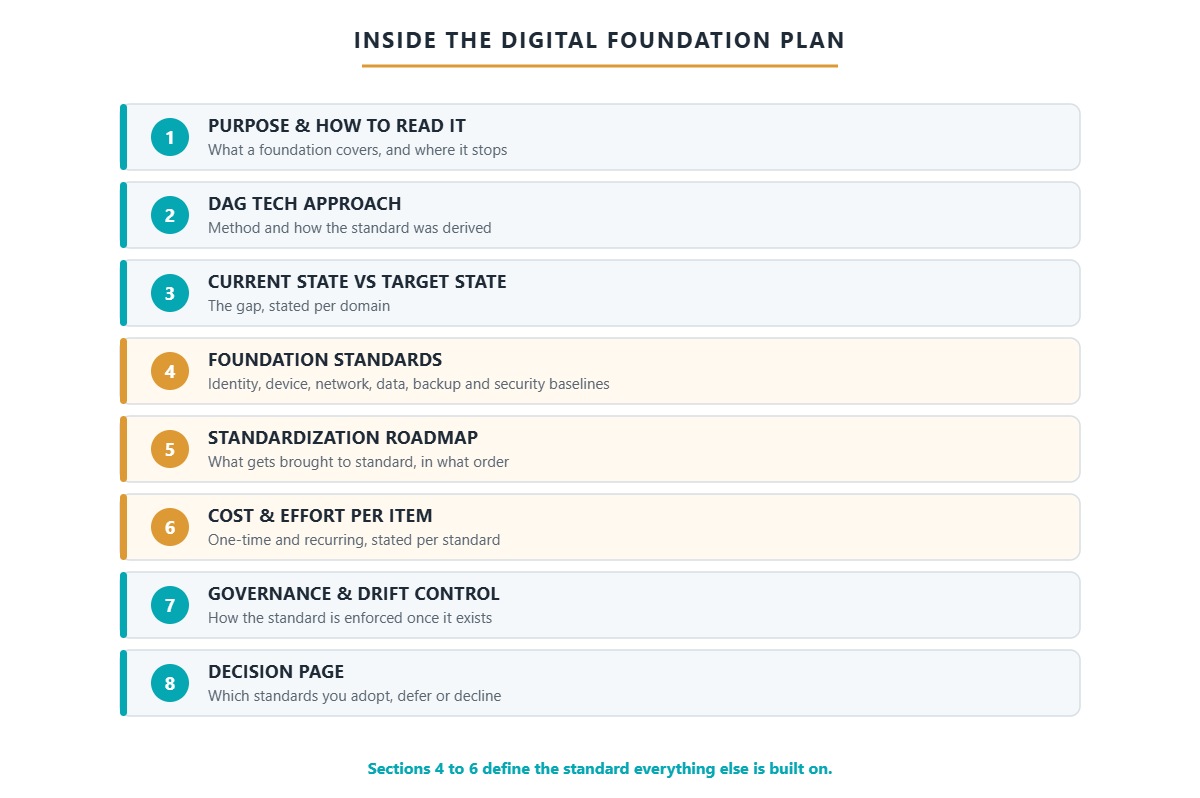
Sections 1–3: Purpose, approach and the gap
What the foundation covers and where it stops, how the standard was derived, then current state against target state per domain, with deviations counted rather than characterized.
Sections 4–6: Standards, roadmap and cost
The standards themselves are the core of the document. Each one carries the same fields:
- Number and domain — identity, device, network, data, backup or security.
- The standard — stated specifically enough to be audited against.
- Rationale — why this standard, and what it prevents.
- Current deviation count — how far the estate is from it today.
- One-time cost and effort — to bring everything to standard.
- Recurring cost impact — which for some standards is a reduction.
- Dependencies — standards that must be in place first.
- Owner and enforcement method — how compliance will be monitored.
Sections 7–8: Governance and the decision page
Drift control, exception handling and project gates, then a decision page listing every numbered standard so leadership can adopt, defer or decline each one. Declining a standard is a valid choice when it is made deliberately and the consequence is recorded.
Where the Digital Foundation Plan Fits
The digital foundation plan is a CxO™ Virtual CTO deliverable that follows the technology assessment and requirements analysis, and precedes the enterprise technology architecture and transformation work. It is also the most common prerequisite we identify during an AI readiness assessment — AI deployments depend heavily on consistent identity and data controls.
Transformation gets the attention and the budget. Foundation work is what decides whether the transformation holds.
Contact DAG Tech today to scope a digital foundation plan for your organization.
Related reading: What Is an Organization Technology Structure? · What Is a Technology Total Cost of Ownership (TCO) Study? · Sustainable IT: Greener by Design