
What Is an Enterprise Technology Architecture?
What Is an Enterprise Technology Architecture?
An enterprise technology architecture is the documented structure of how your systems fit together — identity, network, data, applications and integrations — and the reference every future technology decision gets checked against.
At DAG Tech, the enterprise technology architecture is a CxO™ Virtual CTO deliverable. Where the digital foundation plan sets the standards, the architecture defines how the pieces connect and why they connect that way.
Why Environments Become Unmanageable
Nobody designs an unmanageable environment. It is produced by a series of individually sensible decisions:
- Systems were bought, not designed. Each was selected on its own merits, and integration was handled afterwards.
- Point-to-point integrations multiplied. Twelve systems connected directly to each other produce dozens of bespoke links nobody can safely change.
- Data has no clear owner. The same customer record exists in four systems and none is authoritative.
- Decisions were never recorded. Nobody knows why it was built this way, so nobody will touch it.
- There is no target. Every project optimizes locally because there is nothing to align to.
How DAG Tech Builds an Enterprise Technology Architecture
1. Document the Current Architecture
Objective: Draw what actually exists, not what was intended.
- Systems, their function, their owner and their lifecycle position.
- Every integration: method, direction, frequency and what breaks if it stops.
- Data flows, including the ones running through spreadsheets and mailboxes.
- Identity and access topology — typically where the most unpleasant surprises are found.
2. Establish Architectural Principles
Objective: Agree the rules before debating the diagram.
Principles are decided with leadership and stated plainly: one system of record per data domain, integration through a defined layer rather than point to point, cloud-first with named exceptions, buy before build. Principles settle dozens of future arguments in advance, which is the entire reason for writing them down.
3. Design the Target Architecture
Objective: Define the structure the organization is heading toward.
- Identity layer: Authentication, authorization and privileged access as the foundation.
- Network layer: Segmentation, connectivity and remote access model.
- Data layer: Systems of record, master data ownership and where reporting draws from.
- Application layer: Which platforms serve which business capabilities.
- Integration layer: How systems talk, with API and connector standards defined — the same layer any future AI implementation plan will depend on.
4. Define Transition Architectures
Objective: Describe the intermediate states, because you cannot jump.
Target architectures fail when they present a destination with no route. We define the intermediate states, each one internally coherent and operable, so the organization is never left halfway through a migration with two half-working models running side by side.
5. Record the Decisions
Objective: Preserve the reasoning, not just the outcome.
Each significant decision is recorded with the options considered, the choice made, the reasoning and the trade-offs accepted. Three years on, when someone asks why the organization runs it this way, the answer exists in writing.
What the Deliverable Actually Looks Like
The architecture is a reference document that governs projects for years, so its structure matters as much as its diagrams. Ours runs in eight sections.
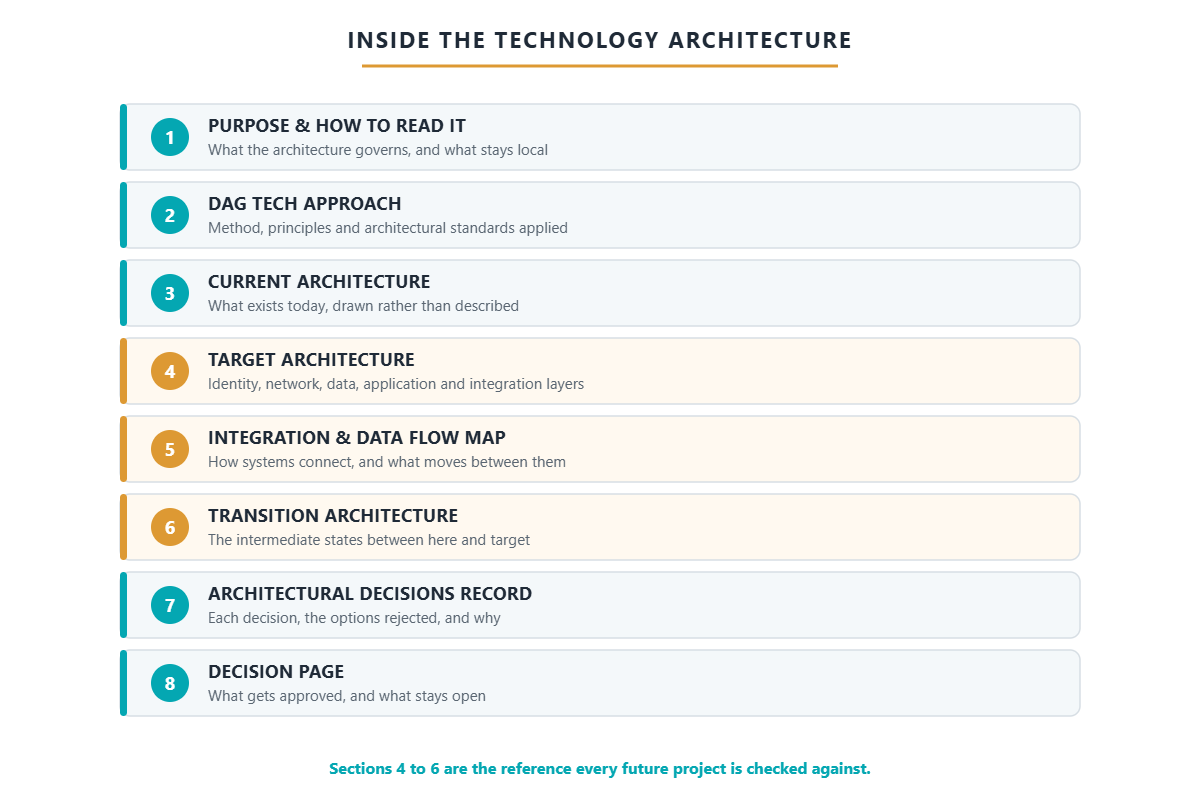
Sections 1–3: Purpose, principles and current architecture
What the architecture governs and what stays a local decision, the principles and standards applied, then the current architecture drawn rather than described — including the integrations nobody documented.
Sections 4–6: Target, integration map and transition
The target architecture by layer, the integration and data flow map, and the transition states. Every system in the target carries the same fields:
- System and business capability served — what it is for, in business terms.
- Position — system of record, satellite, or scheduled for retirement.
- Data owned — which domains it is authoritative for.
- Integration method — API, connector, event or file, with the standard applied.
- Dependencies — upstream and downstream.
- Transition state — which intermediate step it changes in.
Sections 7–8: Decision record and the decision page
The architectural decisions record — each decision, the options rejected and why — then a decision page covering what leadership approves now and what deliberately stays open.
Where the Architecture Fits
The enterprise technology architecture is a CxO™ Virtual CTO deliverable that follows the technology assessment, requirements analysis and digital foundation plan, and governs the projects that come out of the digital transformation plan.
An architecture nobody can point to is not an architecture. It is a pattern that emerged, and patterns that emerge are rarely the ones you would have chosen.
Contact DAG Tech today to scope an enterprise technology architecture for your organization.
Related reading: What Is a Vendor Evaluation Study? · What Is a Technology Total Cost of Ownership (TCO) Study? · What Is an IT E-Learning Program?